Key Points
- Phlebotomists earn a median of $45,230 a year, or $21.75 an hour (BLS, May 2025). The lowest 10% earn under $35,780 and the top 10% earn more than $58,780.
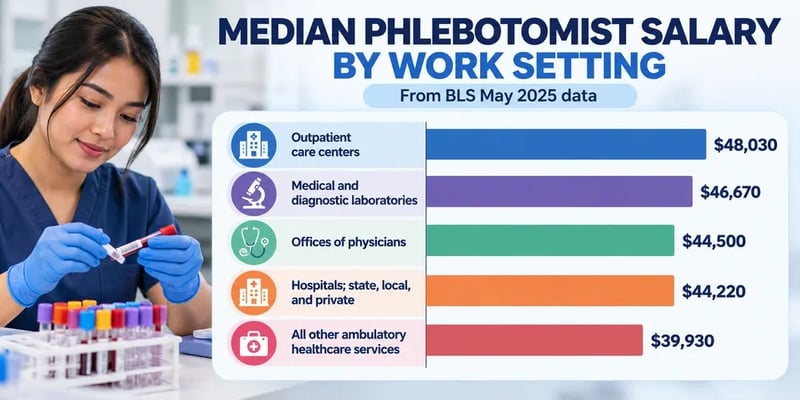
- Work setting shifts the median by thousands of dollars: outpatient care centers pay a median of $48,030, medical and diagnostic labs $46,670, and hospitals $44,220.
- Four states require a state credential to draw blood (California, Washington, Nevada and Louisiana), and large employers such as Quest Diagnostics prefer national certification everywhere else.
- California pays the most at $56,040, and its San Jose, San Francisco and San Diego metros all top $58,000. Louisiana, Mississippi and Alabama pay the least, between $36,120 and $37,220.
- At least 10 states now require pay ranges in job postings, which gives you a legal starting point for negotiation before you ever sit down with a hiring manager.

How Much Does a Phlebotomist Make?
The median phlebotomist salary is $45,230 a year, or $21.75 an hour, based on May 2025 data from the BLS Occupational Outlook Handbook. The lowest-paid 10% earn less than $35,780, and the highest-paid 10% earn more than $58,780, a gap of $23,000 between the bottom and top of the field.
Where you work shapes which of those rows you land in. BLS reports these May 2025 medians for the settings that employ the most phlebotomists:
Demand is steady. Phlebotomists held 143,900 jobs in 2025, and BLS projects 7% growth through 2035, with about 18,000 openings a year as workers retire or move into other roles. Most of those jobs are in hospitals and labs, which together employ more than two-thirds of the field.
Phlebotomist Hourly Wage
Most phlebotomy jobs are hourly, so the hourly figures are the ones to carry into an interview. In the BLS wage percentiles published through O*NET, the national range runs from $17.20 an hour at the 10th percentile to $28.26 at the 90th, with $21.75 in the middle. The phlebotomy technician salary quoted on some job boards is the same occupation under a different title, so the BLS figures apply to both.
Those are straight-time wages. They leave out overtime, shift differentials and bonuses, which is why a hospital phlebotomist who works nights, weekends or holidays can take home more than the median suggests. BLS notes that phlebotomists in hospitals and labs "may need to work nights, weekends, and holidays."
Phlebotomist Salary by State
State is the single largest pay driver in BLS data. California's median of $56,040 sits $19,920 above Louisiana's $36,120, a 55% difference for the same work. Four places pay a median above $50,000: California, the District of Columbia, New York and Massachusetts. Sixteen states pay under $40,000, most of them in the South and Midwest.
Texas, the second-largest employer of phlebotomists with 12,820 jobs, ranks 34th at $40,450, and Florida ranks 35th at $40,230. If you work in Florida, our guide on how much a phlebotomist makes in Florida covers pay by city.
Metro areas stretch the range further. San Jose-Sunnyvale-Santa Clara pays a median of $60,600 ($29.13 an hour), San Francisco-Oakland-Fremont $58,900 ($28.32) and San Diego $58,170 ($27.97). Outside California, the large metros that pay the most are Portland at $51,680, Boston at $50,420, New York-Newark-Jersey City at $49,980 and Seattle at $49,900. No state or major metro has a median above $30 an hour, but the top 10% in San Jose earn more than $45.54 and in San Francisco more than $37.46.
Certifications That Pay Off
Certification moves pay in two ways: it is the law in four states, and it is the filter the biggest employers use everywhere else. BLS does not publish wages by credential, so the honest way to read the pay effect is through the doors a certification opens, which the sections below map to BLS figures.
The four states that regulate the job set the clearest line:
- California requires a state certificate from the Department of Public Health. The entry credential, Certified Phlebotomy Technician I, takes 40 hours of classroom instruction, 40 hours of practical training with at least 50 venipunctures and 10 skin punctures, and a passing score on a national exam from an approved body. The fee is $150, and as of January 1, 2026, the certificate renews every year with three hours of continuing education. CPT II adds arterial punctures after 1,040 hours of experience and 20 supervised arterial draws. Our guide on becoming a phlebotomist in California walks through the application and the 2026 renewal change.
- Washington issues a medical assistant-phlebotomist credential for $145 with no exam, based on a training program or a national certification, renewed every two years.
- Louisiana requires a certificate from the State Board of Medical Examiners, issued on a passing score from a board-approved national exam and renewed every year.
- Nevada certifies phlebotomists as laboratory assistants, with a certificate valid for two years, based on six months of approved training, a national certification, or three years of experience.
Everywhere else, employers decide. Quest Diagnostics' own phlebotomist posting lists certification as "required in certain states, e.g. California, Nevada, Washington and Louisiana," its trainee postings call it "preferred" everywhere else, and Labcorp postings say certification "from an accredited agency is preferred." In BLS data, labs pay a median of $46,670, outpatient centers $48,030, and California $56,040, so the credential is what gets you into the settings and states at the top of the tables above.
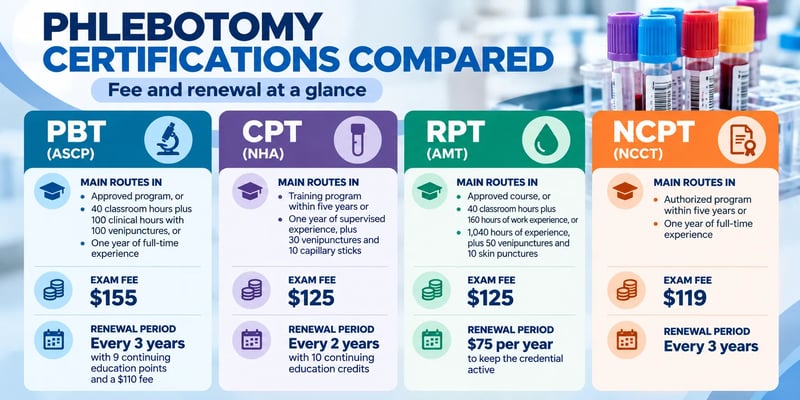
Four national credentials cover most postings. Each accepts a training program or work experience as the route in:
The ASCP exam runs 80 questions in two hours and renews every three years with nine continuing education points and a $110 fee. The NHA exam is two hours and renews every two years with 10 continuing education credits. AMT charges $75 a year to keep the credential active, and NCCT's three-hour exam has 125 scored questions. Whichever you hold, keep it current: a lapsed certificate can cost you a job in a licensing state. Our guide on renewing your phlebotomy certificate covers each body's rules.
If you are still choosing a program, pick one that meets your state's hour requirement and leads to one of these exams. Dreambound lets you compare phlebotomy classes near you by length, cost and schedule, and see which ones include exam preparation or a test voucher.
In-Demand Skills
Employers pay for the draws other people avoid and the tasks that save a lab time. These are the skills that show up in postings and in the exam outlines, and each one strengthens your case for a higher rate.
- Pediatric and geriatric draws. Quest lists "excellent phlebotomy skills to include pediatric and geriatric" as a requirement, and California requires that on-the-job experience counted toward its certificate include patients of varying ages, pediatric and geriatric among them. Small veins, fragile skin and anxious patients are where experienced phlebotomists earn their keep.
- Blood culture collection. Contaminated cultures lead to unneeded antibiotics and repeat draws. The CDC found that venipuncture and dedicated phlebotomy teams both cut contamination, which lab standards say should not exceed 3% of cultures, so hospitals value phlebotomists who can stay under that line.
- Point-of-care and waived testing. Clinics and outpatient centers run glucose, strep and other CLIA-waived tests at the draw station. The ASCP exam gives waived and point-of-care testing 5 to 10% of its questions, and Quest teaches it to new trainees.
- EKG. Many clinics hire one person for blood draws and electrocardiograms. NHA's Certified EKG Technician credential requires 10 documented EKGs and a two-hour exam, and several schools bundle EKG, lab assistant and phlebotomy training into one certificate.
- Specimen processing and lab software. O*NET lists MEDITECH Laboratory and Microbiology and electronic medical record systems among phlebotomists' tools. Accessioning specimens, matching requisitions to tubes and documenting chain of custody are what move you from draw station to lab floor.
- Communication and a second language. BLS names communication skills and compassion among the qualities employers look for, and plasma centers post bilingual English-Spanish phlebotomist roles in some markets.
- Mobile logistics. Home-draw and mobile positions require a driver's license, a clean driving record and the ability to package and transport specimens from nursing homes and private residences.
Pick two or three of these to document on your resume with numbers, such as draws per shift, contamination rate or EKGs performed, and they become negotiating points rather than claims.
Career Moves That Raise Income
The biggest raises in phlebotomy come from changing where and how you work rather than waiting for an annual increase.
Change settings. Outpatient care centers pay a median of $48,030 and medical and diagnostic labs $46,670, against $39,930 in other ambulatory services, an $8,100 spread in BLS data. Outpatient centers employ only 2% of phlebotomists, so those openings are rare, but labs employ a third of the field and pay $2,450 more at the median than hospitals.
Move, or commute, toward a higher median. The state table above is the map. A phlebotomist who moves from Louisiana to Oregon moves from a $36,120 median to $49,160, and the San Jose, San Francisco and San Diego metros pay $58,000 or more. Weigh those figures against housing costs before you relocate; California's prices run about 11% above the national average on the Bureau of Economic Analysis 2024 price index, which takes some of the shine off its $56,040 median.
Step into lead and supervisor roles. The first step up is usually a lead role. Harris Health in Houston requires a certified phlebotomist with three years of experience for its lead phlebotomist role, which oversees the draw and specimen processing areas when the supervisor is out, assigns workstations and monitors staff competencies.
Washington State's classified service describes its phlebotomist lead as checking and recording the work of other phlebotomists and training new hires, and its supervisor as monitoring quality, safety and infection control and helping prepare budgets, with one and two years of experience listed as the expected background. BLS does not report lead or supervisor pay separately, so ask what the step up pays at your own employer.
Take mobile or donor-center work. Mobile phlebotomists travel to patients' homes and nursing facilities, collect and package specimens for transport, and confirm visits by phone; postings for these roles list a driver's license, expense reimbursement and on-call or weekend hours.
Plasma and blood centers hire phlebotomists to perform donor venipuncture, run plasma collection equipment and monitor donors for reactions, and CSL Plasma's postings ask for six months of phlebotomy experience rather than a specific certification. BLS folds both into the same occupation, so there is no separate wage series, but both expand the employers you can apply to.
Teach. California allows a certified phlebotomy technician with three years of experience in the previous five to instruct in a state-approved program, and AMT offers an instructor route to its credential. Teaching can add a second income stream on top of draw work.
Use phlebotomy as the first rung. Clinical laboratory technician and nursing roles require additional degrees and licenses, and phlebotomy experience gives you the specimen-handling and patient-care background they build on.
Negotiation Tips
Phlebotomist pay is hourly, posted and increasingly public, which makes it easier to negotiate than many people assume. Five steps keep the conversation grounded in numbers.
- Anchor to BLS, not to a job board. Bring the median for your state and metro from the table above, plus the setting median. A lab in Oregon offering $21 an hour is offering below the state median of $23.63, and you can say so.
- Get the range before the interview. At least 10 states require employers to post a pay range, among them California, Washington, Colorado, New York, Illinois, Minnesota, Massachusetts, New Jersey, Vermont and Maryland, with employer-size thresholds that vary by state. In New York, for example, any employer with four or more employees must post a good-faith salary range. In those states the posting tells you where the top of the band is, so aim for the upper half if your experience supports it.
- Compare notes with coworkers. The National Labor Relations Board protects your right to discuss pay with other employees, and employers cannot retaliate for it. Knowing what the phlebotomist on the next station earns is the fastest way to find out whether you are underpaid.
- Ask for more than the base rate. Shift differentials for nights and weekends, certification exam reimbursement, paid continuing education hours, and a pay bump when you add point-of-care testing or EKG duties are all easier to win than a straight raise, because each is tied to something the employer needs.
- Time the ask. The strongest moments are the day your certification posts, the end of your first year, and the week you take on a new duty. Put the request in writing with the BLS figure, your draw volume and any specialty skill, and ask for a specific hourly number rather than "a raise."
If the answer is no, ask what would change it and when, then revisit the conversation on that date. Phlebotomists who switch employers for the settings at the top of the BLS table often find the raise waiting on the other side.
Featured Phlebotomy Programs on Dreambound
Certification starts with a program that meets your state's hours and leads to a national exam. These partner programs on Dreambound list their cost, format and exam preparation up front so you can compare them quickly.
- Format: Hybrid
- Length: 6 weeks
- Cost: $1,095 total, $332 to start
- Prepares for the NHA Certified Phlebotomy Technician exam; completion requires 30 unassisted venipunctures and 10 capillary sticks on live patients
- Approved by the Texas Workforce Commission
The same program also runs at the San Bernardino campus in Ontario and the Riverside campus in Temecula.
- Format: In person
- Length: 6 weeks, 100 clock hours
- Cost: $2,295 total
- Approved by California's Laboratory Field Services, the route to the state CPT I certificate
- Includes a 40- to 80-hour externship in an approved facility