Key Points
- Home health aides earn a median of $35,800 a year, or $17.21 an hour (BLS, May 2025, which groups them with personal care aides), with the lowest 10% under $27,040 and the top 10% above $45,040. Indeed job postings average $17.57 an hour.
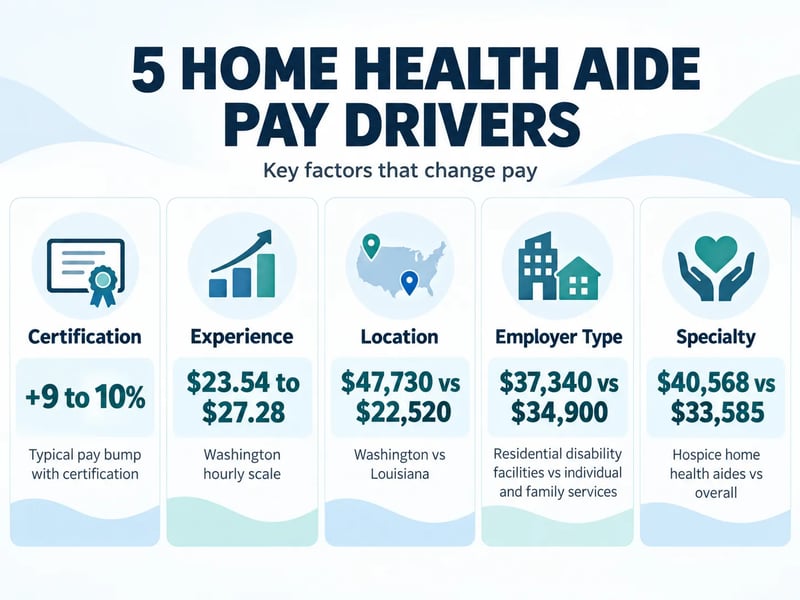
- Certification adds about 9 to 10%: certified home health aides average $36,737 on ZipRecruiter and $16.55 an hour on Payscale, against $33,585 and $15.08 for aides without it.
- Experience pays most where the state sets the scale. Washington's publicly funded aides climb from $23.54 to $27.28 an hour by career hours, and Massachusetts aides from $23.25 to $25.65.
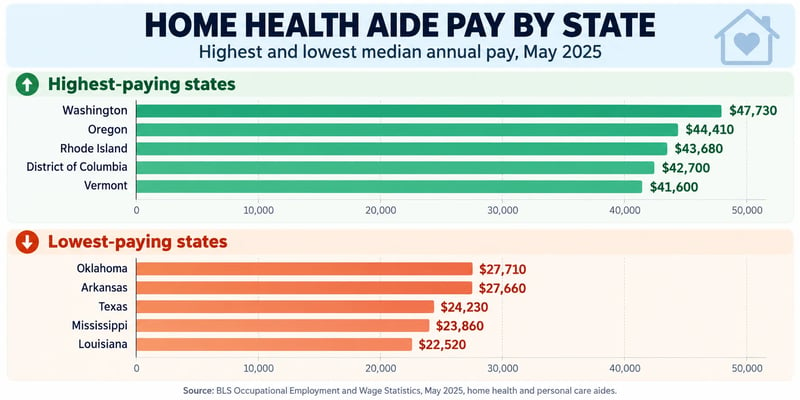
- Washington ($47,730), Oregon ($44,410) and Rhode Island ($43,680) have the highest medians; Louisiana ($22,520), Mississippi ($23,860) and Texas ($24,230) the lowest.
- Hospice work carries the clearest specialty premium, with hospice home health aides averaging $40,568 a year on ZipRecruiter and hospice aides $21.53 an hour on Indeed.

How Much Does a Home Health Aide Make?
The median home health aide salary is $35,800 a year, or $17.21 an hour, according to May 2025 data from the BLS Occupational Outlook Handbook. The lowest-paid 10% earn less than $27,040 and the highest-paid 10% earn more than $45,040. BLS files home health aides and personal care aides in one category, so these figures cover both roles, and they are straight-time wages that leave out overtime and one-time bonuses.
Job-posting sites land close to BLS. Indeed puts the average home health aide (HHA) salary at $17.57 an hour, based on 96,700 salaries from postings over the past 36 months (updated Oct. 12, 2026), with advertised rates running from $12.39 to $24.91 and about $4,000 a year in overtime.
ZipRecruiter reports $33,585 a year, or $16.15 an hour, with the 90th percentile at $41,500 (Sept. 20, 2026). Salary.com estimates $38,657 as of Oct. 1, 2026, and Payscale, which relies on 1,140 self-reported profiles, shows $15.08 an hour (June 23, 2026).
The lower figures tend to come from aides reporting their own pay, and the higher ones from employers advertising open roles. Hours matter as much as the rate. PHI, the research group that tracks the direct care workforce, puts the median wage for home care workers at $16.77 an hour in 2024 but median annual earnings at only $22,429 (2023 data), because so many aides work part-time hours.
If you are weighing the job itself, our guide on what a home health aide does covers the day-to-day work behind these numbers.
Home Health Aide Hourly Wage
Most HHA salary listings quote an hourly rate rather than an annual figure. In BLS data, the hourly range runs from $13.00 at the 10th percentile to $21.65 at the 90th, with $17.21 in the middle. Indeed's posted range of $12.39 to $24.91 is a little wider at both ends, and Payscale's self-reported range runs from $11.03 to $20.27.
Two rules shape what an hourly rate is worth. Under the Fair Labor Standards Act, time spent traveling between clients during the workday counts as paid hours, so an agency that schedules three clients across town owes you for the drives in between.
Overtime is less settled. Since July 2025 the Department of Labor has paused enforcement of the 2013 rule that extended overtime pay to agency home care workers while it considers rolling the rule back. The rule is still on the books and workers can still bring claims under it, but with federal enforcement on hold, your state's law and your employer's policy decide what you actually see. Ask before you accept a schedule that runs past 40 hours.
Education and Certifications
Training requirements start with a federal floor. Any home health agency or hospice that bills Medicare must put its aides through at least 75 hours of training, with at least 16 classroom hours before at least 16 hours of supervised practical work, followed by a competency evaluation run by a registered nurse. Aides then complete 12 hours of in-service training every year. A certified nursing assistant in good standing on the state registry can qualify without a separate program, so CNAs can move into home health work without retraining.
States can set the bar higher. California requires a 120-hour program and an exam for its home health aide certificate, or a 40-hour program for aides who already hold a CNA certificate, and renewal takes 24 hours of continuing education every two years. Washington requires its home care aides to pass a state certification exam after 75 hours of training and complete 12 hours of continuing education a year. New York maintains a Home Care Registry that lists aides who have completed state-approved training.
Certification is also the first pay driver you control. Two sources that measure pay differently both show a premium of about 9 to 10%:
- ZipRecruiter: certified home health aides average $36,737 a year, or $17.66 an hour (Oct. 20, 2026), against $33,585 for home health aides overall, a gap of $3,152.
- Payscale: certified HHAs report $16.55 an hour across 411 profiles (June 1, 2026), against $15.08 for the general title, a gap of $1.47 an hour.
The reason is practical. Medicare-certified agencies and hospices can only staff their cases with aides who have cleared the federal training and competency rules, so certification opens the better-paying employers in the next sections. Private-pay and companion-care agencies can hire without it. If you are starting out, Dreambound lets you compare home health aide training programs near you by length, cost and format, so you can line up a program that meets your state's hour requirement.
Years of Experience
Experience moves home health aide pay most where a public program or union contract spells out the steps. Washington pays its publicly funded individual providers on a 12-step scale tied to career hours. As of July 1, 2026, the scale under the SEIU 775 agreement runs from $23.54 an hour for aides with up to 2,000 career hours to $27.28 an hour above 40,000 hours, and every step rises again on Jan. 1, 2027, to a range of $23.68 to $27.44.
Massachusetts pays personal care attendants in its MassHealth program $19.50 an hour until they finish orientation, then moves them through five seniority steps from $23.25 to $25.65 an hour, based on hours worked, under rates effective Jan. 1, 2026. Minnesota's self-directed care program sets tiered wage floors from $20.00 an hour for new aides to $22.50 above 10,000 cumulative hours, with each tier above the base rising another $0.40 in 2026.
Outside those programs, the climb is flatter. On Payscale, aides with less than a year of experience report $12.82 an hour and aides with one to four years report $14.38, while experienced aides earn about 8% more than the average and late-career aides about 3% more. Raises for time served tend to be small unless the employer has a published scale, so most aides who want a real increase after a few years get it by adding a credential, changing settings, or moving to a higher-paying state.
Experience still counts in ways that don't show up as a rate. The hour counts behind the top steps in Washington and Massachusetts only come with years on the job, and the same is true of Minnesota's tiers.
Location and Cost of Living
Washington pays home health aides the most, with a median of $47,730 a year, or $22.95 an hour, based on BLS data for May 2025, which covers home health and personal care aides together. Oregon ($44,410), Rhode Island ($43,680), the District of Columbia ($42,700) and Vermont ($41,600) follow, and those five are the only places where the median hourly wage reaches $20 or more.
At the other end, Louisiana's median is $22,520, or $10.83 an hour, with Mississippi ($23,860), Texas ($24,230), Arkansas ($27,660) and Oklahoma ($27,710) close behind. The gap between Washington and Louisiana is $25,210 a year for the same work.
Living costs change the order but not the winner. Each state's median was divided by its 2024 Regional Price Parity, the latest state price index from the U.S. Bureau of Economic Analysis. An index of 110 means prices run 10% above the national level, so New York's $39,620 median (index 107.9) buys roughly what $36,700 would at average U.S. prices, while North Dakota's $39,440 (index 89.0) stretches to about $44,300.
Home Health Aide Salary by State
Washington holds first place on both measures. North Dakota climbs from ninth to second once prices are counted, South Dakota from 18th to fifth, Iowa from 25th to seventh, Kentucky from 21st to eighth, and Nebraska from 24th to ninth. The expensive states slide: New York drops from eighth to 23rd, Hawaii from 15th to 33rd, New Jersey from 19th to 35th, and California from a tie for 31st to 44th. Texas, Louisiana and Mississippi stay at the bottom either way. The table lists all 50 states and DC, sorted by cost-adjusted pay, using the BLS May 2025 medians.
Twenty-five states and DC have medians at or above the national $35,800, and 10 states sit below $30,000, all of them in the South and Southwest apart from Pennsylvania.
Home Health Aide Pay Raises in 2026
Several states set their own wage floors for home care, and most of them rose in 2026:
- New York's home care aide minimum wage rose to $19.65 an hour in New York City, Long Island and Westchester and $18.65 in the rest of the state on Jan. 1, 2026, and it climbs to $20.00 and $19.00 on Jan. 1, 2027. Our guide to becoming a home health aide in New York covers the registry and training steps.
- California's statewide minimum wage reached $16.90 on Jan. 1, 2026, and counties set higher rates for In-Home Supportive Services (IHSS) providers. San Francisco's rate rose to $23.00 an hour in January 2026 and $25.00 in September 2026, and it reaches $25.50 in January 2027. Statewide, the Legislative Analyst's Office put the average IHSS wage at $18.66 an hour in January 2025. See our guide to becoming a home health aide in California for the 120-hour certificate.
- Washington's individual-provider scale rose to $22.63 to $26.22 an hour on Jan. 1, 2026, and again to $23.54 to $27.28 on July 1, 2026, with a further step to $23.68 to $27.44 due on Jan. 1, 2027.
- Massachusetts set its personal care attendant steps at $23.25 to $25.65 an hour on Jan. 1, 2026, and Minnesota added $0.40 an hour to every experience tier above its base rate on the same date.
Metro areas follow the same map. Seattle-Tacoma-Bellevue leads the large metros at $48,210 ($23.18 an hour), with Portland-Vancouver-Hillsboro at $45,570 and Boston at $40,910. New York-Newark-Jersey City, home to 644,700 aides, pays a median of $39,680 ($19.08), while Los Angeles ($34,320), Houston ($23,440) and Dallas-Fort Worth ($26,900) sit well below it. San Francisco-Oakland-Fremont's BLS median is $35,950 ($17.28), far under the $28.30 an hour that Indeed's San Francisco page shows, because the BLS figure covers aides at every employer across the metro, while Indeed's comes from 80 postings.
Employer Type and Industry
Who employs you matters as much as where. BLS reports these May 2025 medians for the settings that hire the most home health and personal care aides:
Half of all aides work in individual and family services, the category that covers nonmedical home care and many consumer-directed programs, and it pays the least. Facility-based employers pay the most but hire the fewest. Home healthcare services, which includes the Medicare-certified agencies that require the 75-hour training, sits in between and employs about one aide in four.
Within those categories, four kinds of employers set pay in different ways:
- Consumer-directed Medicaid programs such as California's IHSS and New York's CDPAP pay rates set by the county or the state, so your wage is public and moves with each budget cycle.
- Medicare-certified home health agencies and hospices are paid through Medicare and Medicaid and can only use aides who have cleared the federal training rules; the home healthcare services category they belong to has a BLS median of $36,230, above individual and family services.
- Private-pay and franchise home care agencies set their own rates. On Glassdoor, aides at Visiting Angels report $15 to $18 an hour, and aides at Comfort Keepers and Help at Home report $15 to $17.
- Group homes, assisted living communities and residential disability facilities pay facility-style wages and lead the BLS table.
Two federal policies will shape agency pay over the next few years. The Medicaid Access Rule requires states to make sure at least 80% of Medicaid payments for home health aide, personal care and homemaker services goes to direct care worker compensation, with reporting from July 2028 and the standard taking effect July 9, 2030.
The Department of Labor suspended enforcement of its 2013 home care overtime and minimum wage rule on July 25, 2025, while it weighs a proposal to return to the pre-2013 exemptions, so until a final rule is issued, overtime for agency aides rests on state law and on workers bringing their own claims.
Specializations
Specialty skills raise home health aide pay in two ways: they qualify you for employers that pay more, and in some programs they carry a formal differential.
Hospice is the clearest example. Hospice aides work under the same 75-hour training and 12-hour in-service rules as home health aides, but they care for patients in the last months of life and work alongside a hospice nurse. ZipRecruiter puts hospice home health aide pay at $40,568 a year, or $19.50 an hour (Oct. 20, 2026), about 21% above its figure for home health aides overall, and Indeed's hospice aide postings average $21.53 an hour across 1,900 salaries (Oct. 11, 2026), compared with $17.57 for home health aide postings.
Complex care pays a differential in the states that define it. Massachusetts pays a complex-care differential on top of its seniority steps under its personal care attendant contract, and Minnesota pays a 12.5% enhanced rate for the care of its highest-need clients as of Jan. 1, 2026. Dementia care is a common employer request, though no national source tracks a pay premium for it. The Certified Dementia Practitioner credential from the NCCDP requires a year of paid experience with people living with dementia, an eight-hour seminar and a $185 fee, and it is valid for two years.
Live-in and 24-hour care is where pay structures differ most, which is why salary sites disagree so widely: ZipRecruiter lists live-in caregivers at $46,742 a year, while Salary.com lists live-in home health aides at $32,056.
Live-in work is usually paid as a daily rate, and under federal rules an employer can exclude up to eight hours of sleep time from a 24-hour shift only if you get at least five uninterrupted hours and the arrangement is agreed in advance. Any time you are called to help counts as work. Before taking a live-in role, convert the daily rate to an hourly figure using the hours you will actually be on duty.
The largest step up is the move to nursing assistant. Because a CNA on the state registry already meets the federal home health aide standard, dual-certified aides can work in both home care and facilities, and bridge programs are short. Washington's home care aide to CNA bridge runs about three weeks for $1,100 plus $150 in fees at one approved school.